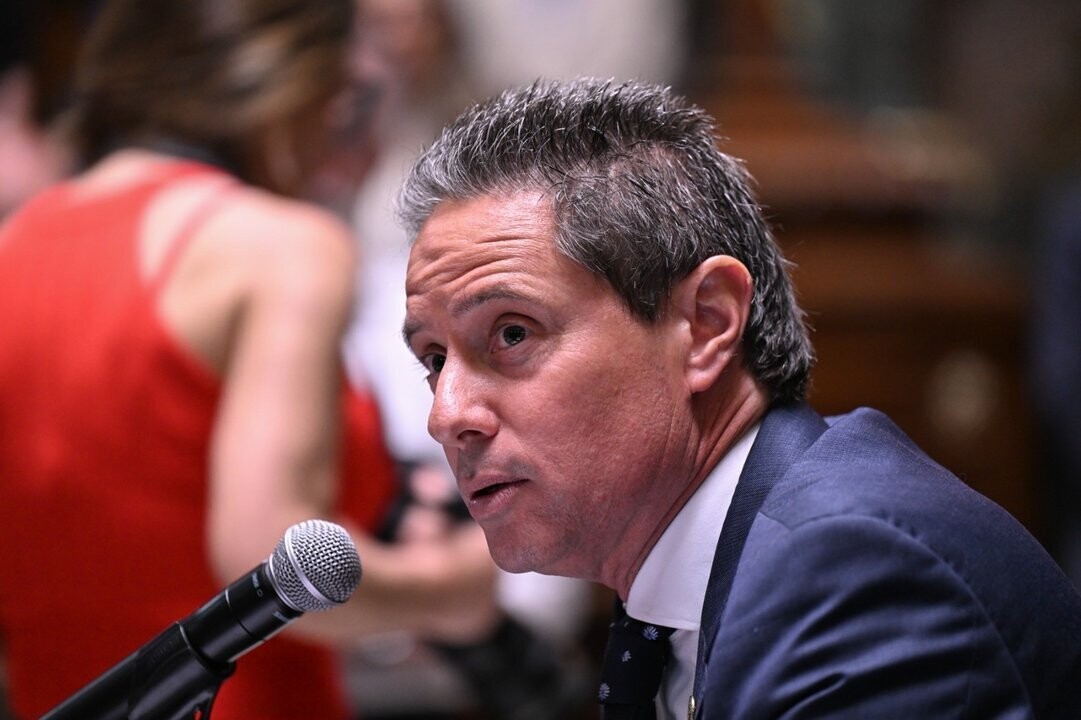
Buenos Aires, Dec 1 (NA) – The head of the Buenos Aires Cabinet, Gabriel Sánchez Zinny, presented his management report this Monday at the Legislature, providing a semi-annual balance of the City's government, focusing on public works, mobility, and subway advancements.
In a session that lasted for several hours, Sánchez Zinny described an administration organized around five central axes: “Square Meter (continuous improvement of hygiene, transit, and security), Connectivity (connection and growth of the City), Care (strengthening of education, health, and human development), State Reform (agility, efficiency, and proximity), and an Attractive City (economic, cultural, and tourist development)”.
One of the pillars of the presentation was the consolidation of the “Square Meter” axis, focused on the continuous improvement of security, transit, and urban hygiene.
In terms of security, Sánchez Zinny highlighted the incorporation of 2,500 new agents and the expansion of the force's vehicle fleet (126 pickups, 120 patrol cars, 160 motorcycles, 60 quads, 6 transfer units, and 11 minibuses).
“Thanks to sustained investment in technology, with 1,200 new cameras installed at 300 strategic points and the Digital Ring controlling over 3 million vehicles per day, the City reached an 82% public space video surveillance coverage,” he stated.
According to the presentation, this strategy, combined with police presence, resulted in a cumulative decrease of 28.4% in robberies and 21.7% in thefts so far this year.
Vehicle theft showed a historic drop of 55%, reaching the lowest number of cases in the last 23 years compared to 2024.
Furthermore, in terms of public order, the recovery of public space stood out, with the liberation of 12 commercial corridors, the removal of 18,040 illegal vendor stalls (recovering 576 city blocks), and the return of more than 500 usurped properties to their owners.
Under the “Mobility” axis, the management highlighted the launch of large-scale projects to improve connectivity.
The most relevant news was the pilot test of the Trambus on Avenida Juan B. Justo in November, the first stretch of the future Line T1, a new system that in 2026 will connect the City from north to south, crossing eight neighborhoods in six communes and connecting with five of the six subway lines.
In the subway network, the official mentioned that in October, the bidding for the construction of Line F was finalized, the first new line in 25 years, which will unite Barracas with Palermo over a 9.8-kilometer route, with an estimated investment of 1.35 billion dollars.